Author Archives: Barbara

Killing the Spiritual but Not Religious Buddha

Sam Harris is coming out with a new book called Waking Up: A Guide to Spirituality Without Religion, as if the world needs another “spiritual but not religious” book. I did a search in Amazon books for “spiritual but not religious” and easily got more than 2000 results.

As I complained awhile back (“My Heresy on Spiritual but Not Religious“) —

“Spiritual but not religious” has become a new orthodoxy. In some circles one cannot say anything positive about “religion,” even in a generic way, without being informed one is behind the times.  Religion = bad. Spiritual = good.  Religion is divisive and dogmatic and corrupt. It is riddled with sexual predators and scam artists. It is interested only in its own power. Spirituality, on the other hand, is all about free thinking, self-affirmation and happy folks tripping down the path of love and light.

Yeah, whatever. I’m spiritual and religious. Sue me.

Brilliant as ever, in the New York Times, Frank Bruni congratulates Harris for recognizing a growing trend —

Harris’s book, which will be published by Simon and Schuster in early September, caught my eye because it’s so entirely of this moment, so keenly in touch with the growing number of Americans who are willing to say that they do not find the succor they crave, or a truth that makes sense to them, in organized religion.

Next up: Bruni discovers Crocs!

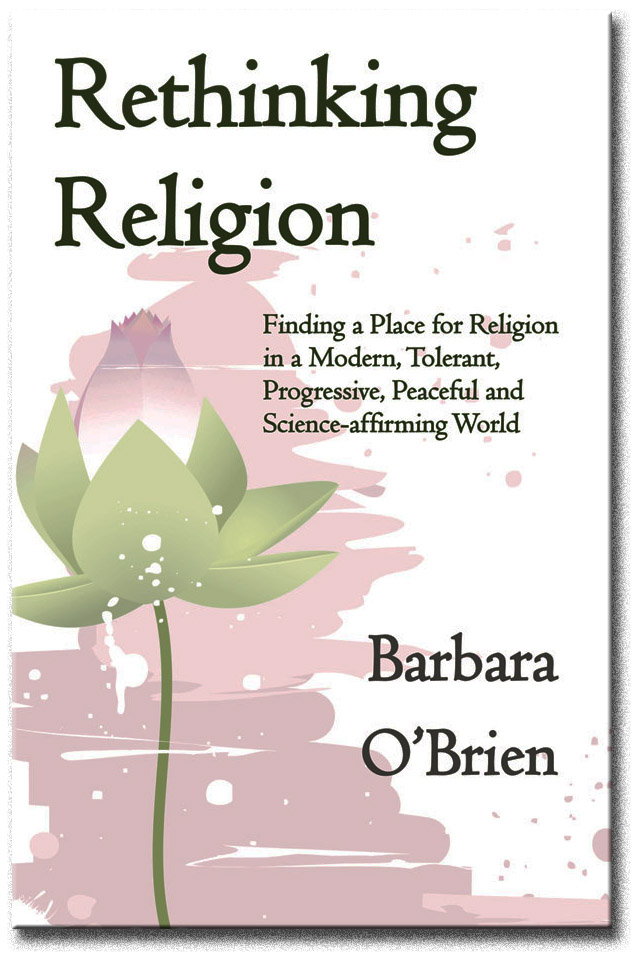
I devote most of a chapter in Rethinking Religion to why I think the trend of separating religion and spirituality, while understandable, is a bad idea. Of course, spirituality is ever a vaguely defined thing, and often what is really meant is closer to one definition of mysticism. From Rethinking Religion:

…a mystical experience in this sense is one that is neither sensory nor conceptual. It is not dependent on seeing visions or hearing voices. It is not generated by reason or intellect. Through this experience, one may feel an intimate connection of existence beyond self, or realize something about the nature of reality not perceived before.

The spiritual-but-not-religious crowd calls these spiritual experiences, but it’s the same thing. Prominent atheist Sam Harris (author, neuroscientist, co-founder of Project Reason) has written quite a bit about spiritual experience, such as —

There is no question that people have “spiritual” experiences (I use words like “spiritual” and “mystical” in scare quotes, because they come to us trailing a long tail of metaphysical debris). Every culture has produced people who have gone off into caves for months or years and discovered that certain deliberate uses of attention—introspection, meditation, prayer—can radically transform a person’s moment to moment perception of the world.

— although Harris is determined to not connect these experiences to religion in any way, because of the “metaphysical debris.” People might erroneously think they’re having an experience of God or Brahman or some such, which is atheistically incorrect. Of course, God or Brahman can be understood in many different ways, to be discussed in the next chapter.

There is no question that religious doctrines provide a context in which people make sense of mystical experience. A few days ago I wrote a post about disturbing meditation experiences, which often seem to happen when people have intense mystical (as I’m defining it) experiences with no context or guidance.
Available at Amazon!

It may be that once practice-realization has ripened all the contexts drop away, like dropping the raft once on the other shore. But that has to happen in its own time. If you’re still living in a fog of concepts and projections you need some context.

In some religious traditions mystical experiences are interpreted to support and confirm doctrine. In others, however, doctrine plays a supporting or guiding role for mystical experience.  Sometimes doctrines are not to be “believed in” but are understood to be provisional explanations of the great ineffable thing one may realize directly through mystical experience. And sometimes gods, angels, dharmapalas and bodhisattvas are understood to be metaphors or archetypes rather than sky fairies.

Sam Harris will have none of that metaphysical debris, however. Frank Bruni asked him about this.

“You can have spiritual experience and understand the most thrilling changes in human consciousness in a context that’s secular and universal and not freighted with dogma,” he said when we spoke on the telephone last week.

In short, Sam Harris demands of the cosmos that it not bother him with anything that rocks his chosen worldview, and that’s his doctrinal context.

Some years ago Harris wrote an essay called “Killing the Buddha” in which he wrote,

The ninth-century Buddhist master Lin Chi is supposed to have said, “If you meet the Buddha on the road, kill him.” Like much of Zen teaching, this seems too cute by half, but it makes a valuable point: to turn the Buddha into a religious fetish is to miss the essence of what he taught. In considering what Buddhism can offer the world in the twenty-first century, I propose that we take Lin Chi’s admonishment rather seriously. As students of the Buddha, we should dispense with Buddhism.

One suspects old Lin Chi (Linji Yixuan, d. 866) would have given Harris several smacks in the head for this. In Zen, “killing the Buddha” means to let go of all concepts and preconceived ideas about Buddha — including the idea that Buddha is a separate thing that could be “met” — because such expectations get in the way of realizing Buddha. Harris is not killing the Buddha; he is merely replacing a version of Buddha he doesn’t like with one he does.

I’m sure many would argue that Harris’s self-imposed doctrinal parameters are at least rational, as opposed to belief in imaginary spirits. But in the context of mysticism they are both fabricated interfaces imposed on a reality beyond the limits of concepts and intellect, impediments to the grace of not knowing, and I don’t know that one is any more or less opaque than the other.

Surrender Has No Goal

In the last post I talked about the differences between surrender and submission. I’m basing much of this on a new book by Zen teacher Barry Magid, Nothing Is Hidden: The Psychology of Zen Koans. I want to discuss this just a little more, because it’s something that a lot of us (me too) need to clarify.

Available at Amazon!

Of course, I’m not using “surrender” in the military sense, but in the sense of liberation from clinging and from our self-imposed limitation of, well, self. This is not something we can will ourselves to do; it happens when conditions are ripe for it to happen.

Submission is something we choose to do, and of course if we’re in anything like a traditional practice we choose to submit to the disciplines of practice. And that’s fine; gotta start somewhere. As we continue, we find that it’s not always fun to practice, and sometimes we get shoved outside our comfort zones a bit. But we choose to continue, usually because we think we will benefit from it somehow. Again, up to a point, that’s perfectly normal.

This practice we choose may enable genuine surrender. But for some people, submission metastasizes into a stubborn pathology, which can take many forms. It can take the form of submission to the will of authority, the teacher; or to a kind of groupthink, or both. When this happens, students are vulnerable to abuse and exploitation.

Even when the student isn’t exploited, sometimes his or her practice turns on gaining acceptance and approval from the teacher. Then practice becomes all about being a model student who will please the teacher. Barry Magid writes that the defining difference between submission or surrender is that submission is “tied to eliciting a response from another person, whether simple approval, love, or just an absence of criticism or abuse. True surrender, on the other hand, has no goal.”

I’ve also heard of people denying themselves physical comforts, like sleeping on a board instead of a mattress. or forcing their legs into full lotus even when it’s bone-crushingly painful. I honestly don’t see the point, except to give oneself something to brag about.

I said earlier that we may choose to continue to practice even when we run into difficulties, because we believe we will benefit from it. That might be a phase most of us go through; I know I went through it. But if this phase drags on for month after month, year after year, and practice is something you are making yourself do because you think you are supposed to do it, then something’s amiss. At some point practice begins to pull you like a current, and then it’s not just a chore, or a duty. That may be the beginning of surrender.

Ultimately, it’s up to us as students to be very honest with ourselves about what we’re doing. After an abusive teacher-student situation is finally made public, I’ve heard members of the sangha, more than once, admit that they were uneasy about the teacher’s behavior, or with relations within the sangha-group, and they ignored their unease.  So, at the very least, try to not do that.

[This post originally was published on About.com Buddhism on October 3, 2013.]

Submission or Surrender?

(Following up the last post) I want to say a little more about the new book by Zen teacher Barry Magid, Nothing Is Hidden: The Psychology of Zen Koans. This book is not primarily about teacher scandals, but there’s a lot in it that speaks to why they happen.

Available at Amazon!

The chapter on surrender versus submission shows the issue from the students’ perspective.  The koan discussed in this chapter is Tung-shan’s Cold and Heat from the Blue Cliff Record. Very basically, it’s about things we try to avoid. A monk asked Master Tung-shan (Tozan in Japan) how to avoid cold and heat. Master Tung-shan said, “Let the cold kill you. Let the heat kill you.” This is metaphorical killing; the death of discriminating mind that is averse to discomfort — surrendering to cold and heat. There’s a lot more to it, but let’s leave it at that for this discussion.

If you do a keyword internet search for “Buddhism surrender” you get a lot of articles and quotes about the importance of surrender. We surrender our egos to wisdom; we surrender our lives to dharma. As part of that, many of us enter into a formal practice in a particular tradition, with other students, and with a teacher.

So here we are, in some kind of institution participating in long-established practices with other people. We choose to submit to this, even the parts that are boring or make our legs hurt. Our reasons and motivations may differ, but usually we submit to this in the beginning because our lives are bleeped up and we want to make them better. We may also have deep and inexpressible spiritual yearnings for something else that “normal” life doesn’t seem to offer us.

So we submit to a path of practice. What seems to happen next, in some sanghas, is that people sink deeper and deeper into submission. If the teacher is exploitative, students wall up the parts of themselves that are uncomfortable with it. They get caught up in the role of good little soldier dharma students and laugh about the woman who complained that roshi groped her in dokusan.

Roshi may encourage this submission by telling his students that it will help them kill their egos. However, submission and surrender are not the same thing. Barry Magid, who is also a psychoanalyst, writes,

“Psychoanalyst Emanuel Ghent has suggested that the longing for liberation inherent in genuine surrender lies behind the maladaptive compromises involved in submission and masochism. He went so far as to call masochism a ‘perversion’ of surrender, a way in which our longing for genuine release at the deepest level is hijacked by submission to another person’s will.”

Drawing upon Ghent’s work, Barry Magid lists the characteristics that distinguish surrender from submission. I’m not going to go through the whole list in this post, but I want to mention the first couple of items.

First, although the process of spiritual surrender may be guided by another, spiritual surrender is not to another.

Second, surrender is not voluntary. Submission is something you choose to do, but spiritual surrender happens when conditions are ripe for it. This reminds me of the Buddhist understanding of renunciation. In Buddhism, renunciation happens naturally when we thoroughly perceive how our grasping and clinging is causing our difficulties. It’s an act of liberation, not self-denial.

I want to emphasize that the solution to the pitfall of masochistic submission is not to avoid teachers and dharma centers. That’s just another avoidance, another kind of clinging, and it’s not going to help you surrender. And I sincerely believe the majority of teachers and dharma centers in the West are not exploiters. But there is a difference between what is nourishing and what isn’t, spiritually speaking, and it’s good to be able to tell one from another.

[This post originally appeared on About.com Buddhism on October 2,2013.]

Stuck in the Void

[This post originally appeared on About.com Buddhism on September 30, 2013. It sort of goes with the last post, on “Dark Nights and Dukkha Nanas.”]

Available at Amazon!

I’ve written a review of  Nothing Is Hidden: The Psychology of Zen Koans, a new book by Zen teacher Barry Magid. I recommend this book highly to anyone already engaged in Zen practice, Soto or Rinzai. But I think a lot of what it says applies to other schools of Buddhism as well.

Part of the book looks at the question of “how good teachers do bad things,” or how teachers recognized for their insight can turn around and exploit students. This isn’t a problem limited to Zen, of course.

However, speaking specifically of Zen, it’s possible for a student to take a slam-bang nose dive straight into sunyata that leaves his inner demons/neuroses/issues unexamined and untouched. This is certainly not inevitable, and  teachers I have known have all explicitly warned us students not to let this happen. But I know it does happen.

This is explained as being stuck in emptiness. The student experiences the ephemeral nature of self and the inter-existence of beings, but the heart of compassion does not open. Of course, the way it’s supposed to work is that realization of sunyata, the perfection of wisdom, naturally gives rise to compassion. I still trust that it does. But maybe there are realizations off-center from perfect that don’t quite do the job. Magid writes,

“Not only did realization fail to heal the deep divisions in our character, more and more it looked as if for many people, and in particular for many Zen teachers, practice opened up bigger and bigger splits between an idealized compassionate self and a shadow self, where split off and denied sexual, competitive, and narcissistic fantasies held sway.”

I should mention that Barry Magid is an honest-to-gosh psychoanalyst as well as a dharma heir of the late Charlotte Joko Beck. Normally articles and books blending Buddhism and psychology strike me as glib and superficial, but here is an author who understands both disciplines deeply. A lot of what he says rings true for me. Comments?

Dark Nights and Dukkha Nanas

Westerners have been playing with eastern mysticism, and now some of them have had “bad trips” being called “dark nights of the soul.” There’s an article on The Atlantic website by Tomas Rocha, titled “The Dark Knight of the Soul,” about a psychology professor investigating the dark side of meditation. The professor, Dr. Willoughby Britton, is working to “document, analyze, and publicize accounts of the adverse effects of contemplative practices,” the article says.

Available at Amazon!

However, there’s nothing discussed in the article that would be particularly surprising to any long-time practitioner of Zen, Vipassana or other traditional Buddhist meditation practice. It’s pretty much a catalog of the stuff teachers warn us about, actually. And it’s all been documented and analyzed in commentaries going back more than a couple of millennia now, albeit in language a western psychologist might not understand.

Here’s the trajectory, as I see it: First, people don’t take bhavana seriously. And then they say, hey, there’s something to this; and they rip it out of its religious context and turn it into a self-improvement project. And then it gets popular, which means somebody can make money from it, so people with only a half-assed idea what they are doing set themselves up as experts and instructors and open spiritual retreat centers. And then when people who are not being properly guided start to wash up on the crazy shore, some other westerner assumes nobody has noticed this before and investigates it. Brilliant.

Off the top of my head I can think of a couple of Zen dharma heirs with Ph.D.s in psychology and one, Barry Magid, who has an  M.D. in psychiatry, all of whom speak English and even live in the U.S. So it’s not like people with deep understanding of both the practice tradition and psychology can’t be consulted on this. Oh, well.

Most of the negative experiences seem to be related to people doing intensive meditation retreats being led by people not grounded in a Buddhist tradition, or in which participants receive little or no individual guidance and are being pushed into satori before they are ready.

For example, one of the people interviewed in the Atlantic article appears to have had a strong experience of self falling away on his first retreat — and it doesn’t say what sort of retreat this was — but he was unable to integrate the experience with his day-to-day life, and it tore him apart. This sort of integration is a lot of what traditional monastic life, with its quietness and many forms and rituals, is about. To experience something that intensive and then be dumped back into “normal world” with no follow-up guidance is asking for disaster, yes. This is not news.

This guy did more meditation retreats but apparently did not seek out a dharma teacher for personal, one-on-one guidance about what he was going through, at least for several years. And it’s not clear to me that the people he finally did consult were dharma teachers, either, but whatever. In a monastic setting, his issues would have been recognized and a teacher who knew him personally would have guided him through it.

This is exactly the reason Brad Warner has called out Dennis Merzel on his “big mind” retreats, btw. And I acknowledge it doesn’t help when someone like Merzel, who really was given dharma transmission awhile back, ditches the tradition and sells easy enlightenment to the masses for his own profit. Merzel is making a good living marketing satori-palooza blow-your-mind enlightenment but gives no individual guidance, except maybe to those willing to fork out enough money for it. One poor guy who wrote to Warner about Merzel had been pushed into talking about his spiritual and sexual issues in front of the entire assembly of 250 or so retreat participants instead of privately in dokusan, which is not how it’s supposed to be done.

Another person interviewed in the Atlantic article had hallucinations. This is common, especially on long retreats. Usually this doesn’t mean anything; it’s just your nervous system mis-firing. In a Zen setting if a student begins to hallucinate during meditation and tells the teacher about it, the teacher will most likely show the student how to adjust his practice so that the hallucinations stop. But the guy in the article got no help and just freaked out.

The traditional Buddhist meditation practices are not to be messed around with by amateurs. They are powerful means intended to, among other things, deconstruct the way we are conditioned to perceive and understand ourselves and reality. They are not primarily intended to help one de-stress or relax; releasing stress is more of a side effect. In a traditional setting, a student works with a teacher who knows him personally, and the teacher will prescribe to the student what he is to do in his meditation, based on that student’s individual development. Even within the same monastery or dharma center, students in different stages of their spiritual development usually will not all be meditating in the same way, although of course you wouldn’t know that by looking at them.

Yes, meditation can occasionally be blissful, and it can occasionally be disturbing, but one is not “good” and the other “bad.” They are what they are; it’s what you do (or don’t do) with those experiences that matters, and that’s where working personally with a skilled teacher is essential.

The traditional meditation practices have a way of reaching into your psyche to find ugly and deeply buried stuff you didn’t know were there. This is a feature, not a bug; dealing with your personal negative baggage is part of the “process,” so to speak. I mention “dukkha nanas” in the title of the post. “Dukkha nana” roughly means “insight into what makes you miserable.” In advanced Vipassana, I am told, a student looks deeply into his own misery in order to gain insight, and this is not for the faint of heart. But a student would not do this without first building a strong foundation of practice and spiritual maturity.

Just taking something like mindfulness out of its context as part of the Eightfold Path is a bit problematic. I don’t doubt mindfulness by itself has therapeutic value, and I’m happy if mindfulness therapy helps people. But mindfulness without context, or with a self-centered context, could just as easily reinforce negative qualities as positive ones. It should be applied with some caution, and it isn’t always.

See also “Buddhist Meditation and the Dark Night” at About.com Buddhism.

What We Don’t See

Of all the conceits common to humankind possibly the most insidious is that any of us are entirely rational. And often the most irrational people are those who brag about how rational they are.

Available at Amazon!

Even if a person’s basic reasoning skills are sound, the outcome of his reasoning nearly always will be imperfect. That’s because nearly all of us “live” within limited conceptual frameworks that filter and sort information in artificial ways. The way we conceptually interface with reality is based partly on our own experience and partly on how we are culturally conditioned to understand things. And most of us are blind to this, because if we and everyone we know is artificially filtering and sorting information in pretty much the same way, we assume our understanding of reality is the only possible one.

(I wrote quite a lot about this in my book, by the way, explaining the way our limited conceptual frameworks have impacted religion and have largely rendered it ridiculous, but it doesn’t have to be that way.)

Breaking out of the conceptual box we live in usually takes some extraordinary experience — and often a shocking one — to see that we’re living in an artificial world and that the “real” one outside the limits of our awareness is largely alien to us. And most of us amble through life without ever having that experience.

Even though few of us ever perceive that we’re living inside a conceptual box, if we run into people whose conceptual boxes are very different from ours we think those people just don’t understand the real world (meaning our “real world”). I could define maturity, even wisdom, as the ability to appreciate and respect that other people’s “worlds” are just as valid as ours even if they are wildly different. I wrote a few years ago,

My view is that everything we think comes from a complex of psychological discriminations and impulses, little of which have anything to do with “logic.” The way we understand ourselves and the world begins to be shaped from the moment we’re born and continues to be shaped by the culture we grow up and live in. In other words, all of our understandings are biased. This is pervasive and inescapable. Often the difference between “logical” and “empathic” people is that an “empathic” person has at least a dim appreciation of his own biases, whereas a “logical” person is utterly oblivious to them. …

… Our conscious, cognitive understandings of things are based on internalized models of what we’ve been conditioned to believe is “normal.” We may be able to articulate our ideas and perceptions in a coolly logical way, but the process by which we arrive at our ideas and perception is “complex, unconscious and emotional.” This is always true, whether we want to admit it or not. …

… Generally being “fair” is not losing one’s biases, but perceiving one’s biases as biases. If you recognize your biases as biases, you are in a position to overrule them as the facts dictate. But if you are so unconscious of yourself that you don’t recognize your biases as biases, then your “thinking” generally amounts to casting around for support for your biases. Then you put the biases and the cobbled-together “support” together and call it “reason.”

And this takes me to what we don’t see. I’ve written before about the “default norm” syndrome, also called the invisible baseline fallacy, which in our culture means white maledom is the default norm, and perspectives and experiences that deviate from those common to white men are not respected as legitimate. If you are a woman or racial minority in this country you have bumped into this iron wall of assumption many times, but the iron wall is invisible to a lot of white men. Not all, thank goodness.

This is basically the same thing that people are calling “male privilege” or “white privilege,” although I don’t like those terms. The degree to which one’s assumptions, biases and experiences are “privileged” depends on a complex of factors that include health or physical condition, class, and wealth. A white male lower-income paraplegic is considerably less “privileged” than the Koch brothers, for example. As wealth inequality becomes more extreme a whole lot of white people are being left behind to a degree I believe is unprecedented in American history, and I assure you most of these people don’t feel all that “privileged.”

Money is privilege. People who have always been financially comfortable have no idea how much lack of money can be an obstacle to basic functionality in our society. The poor are taxed in myriad ways, from paying higher bank account fees on their meager balances — causing the very poor to not use banks at all, but then one must use check cashing services that also take a bite. Without a car you take public transportation, which eats a lot more time out of your day. And if you don’t have money for a bus you simply don’t go anywhere out of walking distance, which puts a huge limit on your job opportunities. Those left out of Medicaid expansion still have limited access to health care, and chronic, debilitating conditions often go untreated. Poor parents often are caught in the day care trap — they aren’t paid enough to afford reliable day care, but without that it’s hard to hold a job at all. So one is perpetually making seat-of-the-pants arrangements with people to watch the children, and then worrying if the kids are safe. Etc. etc. Many conveniences people with money take for granted are not available to the poor, and the inconveniences pile up and make day-to-day life an exhausting exercise in barely coping.

And then it is assumed the poor can’t get ahead because they are lazy. And it is just about impossible to explain the problem to someone who has been cocooned from it. It’s not part of his, or her, experience; therefore, it isn’t “real.”

As a woman I am sometimes surprised at how much even liberal men are oblivious to the extreme misogyny that still lingers in our culture. I wrote earlier this year,

Even those of us who have never experienced physical assault have experienced sexual intimidation, belittling and humiliation, aimed at us only because of our gender. And most of the time we put up with it, because what else can we do? Confronting some sexist bozo could turn an unpleasant situation into something genuinely dangerous. So how has the political Right responded to #YesAllWomen? Mostly with more belittling. Charles Cooke at NRO, for example, dismisses the social media phenomenon as “groupthink.” We women can’t possibly know our own experiences, apparently, and simply imagine misogyny because we’ve read about it.

Especially to conservatives, problems that middle- and upper-income white men rarely if ever encounter are not “real” issues worthy of being addressed by society or government, but are exceptions that the individuals affected must take care of on their own. The fact that these issues may impact all of us, directly or indirectly, and that the cause may be widespread cultural and institutional bias that upper-income whites feed on a daily basis, is invisible to them. And you can’t explain it to them. No amount of real-world data or well-constructed logic makes dent in the iron wall. If it doesn’t conform to the conceptual box they live in, it can’t be true.

This is why it is good to have diversity of experience represented in decision-making bodies such as governments, for example. White men like to tell themselves they can make decisions that affect everybody else just fine because they will apply reason. But their reason is based on biased perspectives that fail to take many things into account. Publius provides a good example here — many rape laws used to require a woman to show she had resisted an assault to prove she had not consented. But this is a male-centric view. A woman understands that if she is being assaulted by a violent man much stronger than she is, her only hope of surviving may be in not resisting. (I remember a bitter joke from many years ago that the only woman almost certain to win a rape case is a dead nun.)

And don’t get me started on reproductive issues. Just a few days ago I was told I was too emotional because I passionately disagreed that abortion must be criminalized. Naturally it was a man, who will never be pregnant, who said this. Yes it’s easier to be emotionally detached from a issue when it’s not personal, and when the real-world experiences and consequences of that issue are merely hypothetical. It’s easier to be emotionally detached when you’re behind the iron wall.

Michael Brown is being buried today. If his killing, and what we’ve learned about Ferguson, hasn’t given us a clear picture of the evils and pervasiveness of institutional racism I don’t know what else will. Yet just last week I encountered a forum populated largely by white men who couldn’t understand why people are always going on about race. Why is race such a big deal? Isn’t it all about making white men feel guilty?

But I certainly don’t give a rodent’s posterior whether anybody feels guilty. Guilt doesn’t so much as butter toast. Our country is becoming increasingly dysfunctional, in part because our institutions, especially government, increasingly reflect the views of only the most sheltered and privileged among us. And it is increasingly unresponsive to everyone else. And, weirdly, a big chunk of the population being left behind still clings to the cognitive biases that support policies that are hurting them. Their collective conceptual frameworks are not adjusting; they still can’t see past the iron wall.

See also: Andrew O’Hehir, “White Privilege: An Insidious Virus That’s Eating America from Within.”

[First posted on The Mahablog, August 25, 2014]

Don’t Settle for Explanations

I’ve written before about emptying your cup. This is harder than you might realize. By the time we reach adulthood we are so full of, um, stuff that we don’t even notice it’s there. We might consider ourselves to be open minded, but in fact everything we learn is filtered through many assumptions and then classified to fit into the knowledge we already possess.

Read More

The Buddha taught that conceptual thinking is a function of the Third Skandha. This skandha is called Samjna in Sanskrit, which means “knowledge that links together.” Unconsciously, we “learn” something new by first linking it to something we already know. Most of the time, this is useful; it helps us navigate through the phenomenal world.

But sometimes this system fails. What if the new thing is utterly unrelated to anything you already know? What usually happens is misunderstanding. We see this when westerners, including scholars, try to understand Buddhism by stuffing it into some western conceptual box. That creates a lot of conceptual distortion; people end up with a version of Buddhism in their heads that is unrecognizable to most Buddhists. And the whole is Buddhism philosophy or religion? argument is being perpetrated by people who can’t think outside the box.

To one extent or another most of us go about demanding that reality conform to our ideas, rather than the other way around. Mindfulness practice is an excellent way to stop doing that, or at least learn to recognize that’s what we’re doing, which is a start.

But then there are ideologues and dogmatists. I’ve come to see ideology of any sort as a kind of interface to reality that provides a pre-formed explanation for why things are as they are. People with faith in ideology may find these explanations very satisfying, and sometimes they might even be relatively true. Unfortunately, a true ideologue rarely recognizes a situation in which his beloved assumptions to not apply, which can lead him into colossal blunders.

But there is no cup so full as that of the religious dogmatist. I read this at Brad Warner’s place, about a woman friend to interviewed a young Hare Krishna devotee.

“Turns out her Hare Krishna friend told her that women are naturally submissive and their position on earth is to serve men. When Darrah tried to counter this assertion by citing her own real-life experience, her buddy literally went “Blah-blah-blah” and proceeded to talk over her. When Darrah finally managed to ask how he knew all this, the Hare Krishna pointed to a bookshelf and said, ‘I have five thousand years of yogic literature that proves it’s true.'”

This young man is now dead to reality, or reality about women, at least.

And the moral is, don’t settle for explanations. This is not to say that all explanations are wrong, but until the explanation has been tested by experience, then accept it only provisionally.

[An earlier version of this post was published at About.com Buddhism  on August 13, 2012.]

Why China Rewrites History

The so-called Xinjiang autonomous region of China is home to an indigenous population of Uighur Muslims. There has been friction and sometimes violence between the Uighurs and Han Chinese. Over the past year over 200 people have died in ethnic violence in Xinjiang.

Read More About the Roots of Religious Violence

But Beijing has a nifty way to plaster over such problems, or at least soothe the consciences of the Han Chinese. They generate phony happy history! False narratives about China’s past, repeated even in textbooks and scholarly histories, reinforce the belief among Chinese that the minorities among them, including the Uighurs and Tibetans, are members of an extended family of Chinese nationhood with roots going back centuries.

However, the roots are not real, and the only people who don’t realize this are the Chinese. Andrew Jacobs writes for the New York Times:

When it comes to China’s ethnic minorities, the party-run history machine is especially single-minded in its effort to promote story lines that portray Uighurs, Mongolians, Tibetans and other groups as contented members of an extended family whose traditional homelands have long been part of the Chinese nation.

Busloads of Chinese tourists are rolling into Xinjiang to visit a particular Islamic shrine, where an Uighur woman named Iparhan is said to be buried. The Chinese are being told that Iparhan, or Xiangfei in Chinese, was the great love of the Qianlong emperor (1711-1799). He was so intoxicated with her that after she came to live in his palace, he built a replica of her village outside her window to please her. When she died, 120 men escorted her body over 2,700 miles so she could be buried in her homeland.

That’s the Chinese version, anyway. The Uighur version is that Iparhan was a sex slave who was murdered by the emperor’s mother for being insufficiently obedient. And her body was not returned. Archeologists believe she is buried near Beijing.

Which version is true? The New York Times article says the “Disney” version became popular in the early 20th century, but Chinese Communist Party historians have improved on it since. And scholarly historians who say otherwise risk having their careers destroyed. However, the Chinese story of Xiangfei is now a popular topic for plays and television dramas, and commercial enterprises from a chain of roast chicken restaurants to a line of perfume are named in her honor.

What is all this happy talk about? According to this BBC report, Han Chinese moving into Xinjiang are snapping up the best jobs. Further,

Activists say Uighur religious, commercial and cultural activities have been gradually curtailed by the Chinese state. There are complaints that the Uighurs experience severe restrictions in the practice of their Muslim faith, with fewer mosques and strict control over religious schools.

Rights group Amnesty International, in a report published in 2013, said authorities criminalised “what they labelled ‘illegal religious’ and ‘separatist’ activities” and clamped down on “peaceful expressions of cultural identity”.

Last month some Uighur in civil service jobs were banned from fasting during Ramadan, the BBC says.

Be clear that the happy talk is not intended to placate the Uighurs. Instead it is entirely aimed at Han Chinese, who are persuaded that the benevolent rule of China is a great blessing to their more backward minorities. It also is intended to absolve Chinese policy when violence breaks out. Chinese citizens are persuaded that the violence is the result of crazed separatists who are too unreasonable or ignorant to appreciate what China is doing for them.

Disneyfied versions of Tibetan history are used to the same effect. China must maintain the fiction that Tibet has been part of China for centuries in order to persuade the Chinese that the takeover in the 1950s was not just the bare-assed invasion that it was. The New York Times story mentions Princess Wengchen, a daughter of a Chinese emperor given in marriage to the Tibetan King Songtsen Gampo (d. ca. 650). Historians say there was no such princess or marriage, but her story fuels a folk belief in an ancient alliance between China and Tibet.

Beijing has gone so far as to build a Tibetan “Disneyland” in Chengde, which is in Heibei Province northeast of Beijing. Chengde was the site of the summer residence of the Kangxi emperor (1654-1722), and it is a popular tourist destination for the Chinese today. Many of the exhibits and spectacles at the park portray a visit to the Kangxi emperor by the 5th Dalai Lama (1617-1682). During this visit, the exhibits say, the two rulers agreed that  Tibet was a province of China. Richard Bernstein wrote in the New York Review of Books,

Kangxi’s achievement is celebrated in Chengde in an ultra-high-tech theatrical extravaganza called the Kangxi Ceremony that plays nightly in a vast open-air amphitheater about ten miles outside the city. The show begins with several dozen uniformed horsemen galloping across the turf in front of the audience and taking up positions in the suddenly illuminated hills that surround a large circular stage. Amplified drums and a throaty male chorus fill up the night air as an actor playing Kangxi, dressed in lustrous robes of yellow brocade, gallops onto the scene, his horse rearing, cheered on by dozens of surrounding horsemen.

The tourists eat this up. However, the event being so spectacularly portrayed could not possibly have happened. The 5th Dalai Lama did make a well-documented state visit  to Beijing, not Chengde, probably arriving in January 1654. But this was a few months before the Kangxi Emperor was born.  It is documented that during this visit His Holiness was treated as a visiting head of state, not a vassal. And the Great Fifth never went back to China.

See also The Disneyfication of Tibet.

Ryutan Blows Out the Candle

(Note: This is a continuation of the last post, “The Mystic Eye,” and you may need to read that post to make sense of this one.)

Buy the Book at Amazon

“Ryutan Blows Out the Candle” is a classic Zen story from Tang Dynasty China and also a koan, Case 28 of the Mumonkan. It is sometimes also called “Ryutan Renowned Far and Wide,” or variations of that title. The full story has several components, but I’m going to simplify it a bit. I’m also going to use the more familiar Japanese forms of the names of the main characters.

Tokusan (Te-shan Hsüan-chien, 782-865) was a famous scholar, praised especially for his commentaries on the Diamond Sutra. He was invited to lecture far and wide, and as he traveled he carried the scrolls containing his notes and commentaries with him. One day he heard about some teachings of the Zen school on the Diamond Sutra that clearly were wrong, he thought, so he traveled to the monastery of Zen Master Ryutan (Lung-t’an Ch’ung-hsin or Longtan Chongxin) to set the master straight.

The two men met and discussed the Diamond Sutra far into the night. Finally Tokusan prepared to leave, but it was very dark out. Ryutan lit a candle and gave it to Tokusan, but as Tokusan reached for the candle Ryutan blew it out. At that moment, Tokusan experienced deep realization.

The next day, according to the Mumonkan, Tokusan brought his notes on the Diamond Sutra to the front of main assembly hall, pointed to them with a torch, and said,

“Even though you have exhausted the abtruse doctrines, it is like placing a hair in a vast space. Even though you have learned all the secrets of the world, it is like a drop of water dripped on the great ocean.”

And then he burned his scrolls and departed. He eventually became Ryutan’s student and dharma heir.

(Notice: I should put a disclaimer on this post that says “This blogger is not a Zen teacher.” I’m not going to pretend I see everything the koan is presenting. I have a couple of commentaries by Zen teachers at hand, one by the late Robert Aitken and one by my teacher, Susan Postal, and I’m leaning very heavily on what the teachers say. However, whatever I misrepresent is my fault entirely, not the teachers’.)

At the beginning of the story, we have the great scholar Tokusan, who is the Expert. Everyone says so. He says so. And the Diamond Sutra is his baby. For those of you unfamiliar with the sutra, it’s part of the larger Prajnaparamita Sutra, from which also comes the Heart Sutra. The Diamond seems to present one paradox after another, making it especially difficult to “grasp” intellectually, but Tokusan seems to have grasped it that way.

As Aitken wrote,

“If your defenses are impervious, no one can get in–and you can’t get out. There is no fissure through which your vine of life can find its way to the sunshine.”

But on his way to the monastery, Tokusan met a woman in a tea shop who asked him a question about the sutra he couldn’t answer. From the Mumonkan:

When he reached the road to Reishû, he asked an old woman to let him have lunch to “refresh the mind.”

“Your worship, what sort of literature do you carry in your pack?” the old woman asked.

“Commentaries on the Diamond Sutra,” replied Tokusan.

The old woman said, “I hear it is said in that sutra, ‘The past mind cannot be held, the present mind cannot be held, the future mind cannot be held.’ Now, I would like to ask you, what mind are you going to have refreshed?”

Tokusan was dumbfounded by the question. He felt a flicker of doubt. A crack appears! And then he encountered Ryutan, whose insight into the sutra opened the crack further. And after his realization Tokusan burned his scrolls.

Mumon says in his capping verse, “Alas! He lost his eyes!” Aitken says, “He became altogether blind at last!” Here is some classic Zenspeak. In the English language, blindness is often used as a metaphor for ignorance. But it’s not unheard of in Zen Lit to use blindness as a metaphor for wisdom, because one who is blind is not fooled by appearances.

I recently came across a fascinating academic paper on this koan, titled “Approaching the Language of Zen: Clarke, Heidegger, and the Meaning of Articulation in Zen Koans” by Professor Anton Sevilla of the the Ateneo de Manila University in the Philippines. Academic papers on Zen tend to be dreadful, but this one makes some good points I’d like to share. The professor writes,

The light of Ryutan’s candle is likened to words, and in this case, could be likened to the words of the Diamond Sutra and other notes and commentaries. Through this light, Tokusan was able to grasp things, to see them, to navigate about them and so forth. His philosophical purview into the sutras allowed him a mode of articulating reality and grasping it in an intelligible fashion.

However, is this space that is navigable by words and intellect all there is to reality? Candlelight illuminates some things, but leaves other things in the dark.

Here I’m going to go back to the way our brains create reality, discussed in the last post. Very briefly, the way we experience “reality” depends a great deal on the way our brains interpret and organize sensory input. We depend especially on the left temporal lobe, which creates the way we experience time and position, and which also is the part of the brain that generates language, logic, and categories. This includes the categories “me” versus “everything else.”

Our brains evolved in a way to allow us to navigate through space and matter to find food and shelter and each other, and eventually to create civilization, the arts, science, and many wonderful things. For humans, intellect is one of our primary “interfaces” with the world. But it’s also a kind of trap, because we assume there is no other way to know or experience. Yet it’s really more like a candle, illuminating some things but leaving other things dark.

Professor Sevilla speaks of “The tension between the abundance of the coming to light of reality and the finitude of man’s grasp and articulation,” and within that tension is the realm of mystical practice. The mystic seeks to push beyond the boundaries of the left temporal lobe, and to illuminate the places intellect doesn’t reach.

They don’t always succeed, of course, and the word “mysticism” is used to cover everything from Zen practice to fortune telling. But it’s striking to me how the great mystics of the many religions so often seem to agree with each other more than they do with the dogmatists of their own religious traditions.

The story of Tokusan and Ryutan is the story of a man who experienced realization when his intellect dropped away. Intellect isn’t bad, of course. You have to have some cognitive skills to be functional. I sincerely believe more critical thinking would make the world a better place. Yet it can also be a trap, keeping us from seeing the whole thing, so to speak.

Language also is generated by the left temporal lobe, and the languages of humankind are designed to work within the reality created by the left temporal lobe. When you leave that reality, left-temporal-lobe language doesn’t function. Mystics often fall back on poetry, or something like it, to explain what they’ve realized. People tightly locked in linear logical left-temporal-lobe mode usually dismiss such expression outright. Or, they’ll attempt to make sense of it logically, find it riddled with what they think are inconsistencies and paradoxes, and then dismiss it.

And many generations of Zen teachers have told us, don’t get stuck in words. Zen’s definition of itself:

A special transmission outside the scriptures;

No dependence on words and letters;

Direct pointing to the human mind;

Seeing into one’s nature and attaining Buddhahood.

Much of Professor Sevilla’s paper compares Heidegger’s notion of language with the way Zen uses language, and some of you might enjoy reading this. Very briefly, he argues much of Zen language is an “unsaying,” a deconstruction of conventional cognitive frameworks. “In language as ‘unsaying,’ articulations attempt to release human beings from their attachments to particular ways of seeing reality,” he writes.

When the Buddha realized enlightenment, he said,

Oh housebuilder! You have now been caught!

You shall not build a house again.

Deconstruct! Unsay! Blow out the candle! This is not normally how we learn things, but this is what the dharma requires.

Even if you have only a basic knowledge of the Buddha’s story of enlightenment, it ought to be obvious that what he realized was not cognitive knowledge. Yet time and time again, I find very bright, very intellectual people trying to understand Buddhism who can’t “get” that. If you explain to them that an intellectual approach won’t work, they smile indulgently at you, as if you were a small child talking about Santa Clause, and go back to labeling, categorizing, and constructing. It’s quite astonishing.

As Dogen wrote in Genjokoan,

When you see forms or hear sounds fully engaging body-and-mind, you grasp things directly. Unlike things and their reflections in the mirror, and unlike the moon and its reflection in the water, when one side is illumined the other side is dark.

[This post originally appeared on About.com Buddhism on October 6, 2010]